Reproducible Manuscript Template
Unit Testing for Science - A framework for automated manuscript verification
View the Project on GitHub ylecoyote/reproducible-manuscript-template
Unit Testing Science: The Case for Reproducible Manuscripts
“I almost published a paper with a 70% error in a key figure. My code was correct. My data was correct. But the figure file in the folder was three weeks old.”
This is the nightmare of every computational scientist. You change a parameter, re-run the analysis, and get a slightly different result. You update the abstract, but forget to update Table 2. You update the code, but forget to regenerate Figure 4.
The result is Manuscript Drift: the silent divergence between what your code actually computes and what your paper says it computes.
    graph LR
    A[Analysis Code] -->|Generates| B(Data & Figures)
    B -->|Manual Copy-Paste| C[Manuscript Text]
    C -.->|Drift!| A
    style C fill:#f9f,stroke:#333,stroke-width:2px
The Problem: The Dangerous Gap
In modern science, we have rigorous tools for code (Git, CI/CD, Unit Tests) and rigorous tools for writing (LaTeX, Overleaf). But we have almost no tools for the connection between them.
Most scientists rely on manual synchronization:
- Run script.
- Look at terminal output (
efficiency = 0.824). - Type
0.824into LaTeX. - Repeat for 50+ numbers.
This process is fragile, manual, and unscalable. It relies entirely on human memory and discipline. In software engineering, we know that hope is not a strategy.
The Solution: Reproducible Verification
We propose a new paradigm for scientific publishing: Reproducible Manuscripts with Contract-Driven Verification.
Instead of manually copying numbers, we define a Single Source of Truth (SSOT) that serves as a contract between the analysis and the text.
1. The Contract (numerical_claims.yaml)
We move all numerical assertions out of the text and into a machine-readable file. This file defines exactly what the paper claims.
# numerical_claims.yaml
results:
  experiment_a:
    efficiency: 0.854   # The paper claims 85.4%
    p_value: 0.04       # The paper claims significant result

figures:
  required:
    - filename: "fig1_efficiency.png"
      generator: "plot_efficiency.py"
2. The Enforcer (Verification Script)
We run a lightweight script that compares your Raw Data (CSVs, Logs) against your Contract.
- Does the CSV say 0.82? But the Contract says 0.85? → FAIL.
- Is
fig1.pngolder thanplot_efficiency.py? → FAIL. - Is the P-value within tolerance? → PASS.
3. The Gatekeeper (Git Hook)
We install a pre-commit hook. If you try to commit changes while the manuscript is inconsistent, git refuses the commit.
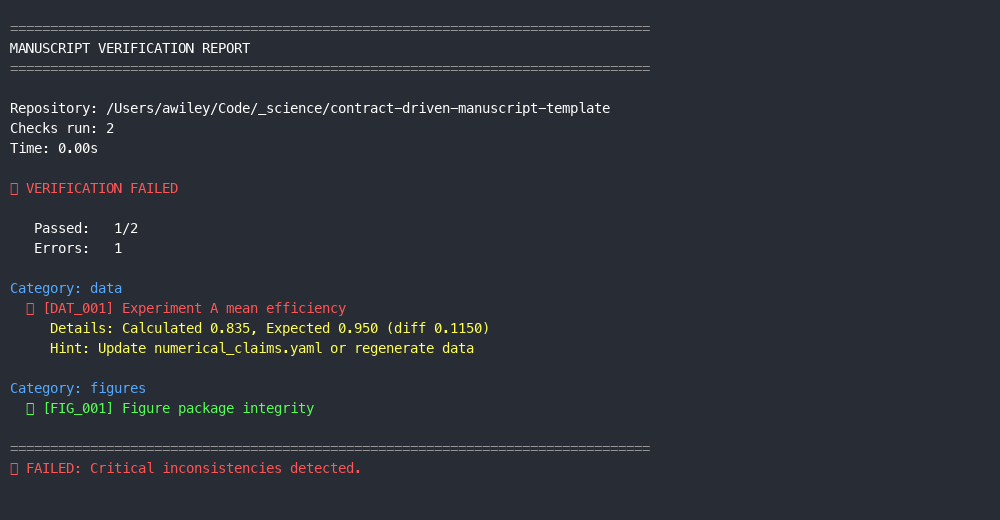
Example output when verification fails:
❌ [DAT_001] Experiment A Efficiency
    Details: Calculated 0.821, Expected 0.854
    Hint:    Update numerical_claims.yaml or fix analysis code.
⛔ FAILED: Commit blocked.
The “Gallery of Failure”
This system is designed to catch the specific, subtle errors that lead to retractions and errata:
- The Stale Figure: You tweaked the font size in the plotting script but didn’t re-run it. The repo contains the old version.
- The “Zombie” Number: You mention “5.9σ tension” in the Introduction, but your new analysis found “5.1σ”. You updated the Results section but forgot the Intro.
- The Rounding Error: Your code outputs
0.049, but you typed0.04in the paper. The verifier catches this precision loss.
Getting Started
We have open-sourced this framework as a GitHub Template. You don’t need to change your entire workflow to use it.
- Clone the Template: Start your next paper with our structure.
- Define your Claims: Fill out the YAML file.
- Sleep Soundly: Know that your manuscript is mathematically consistent.